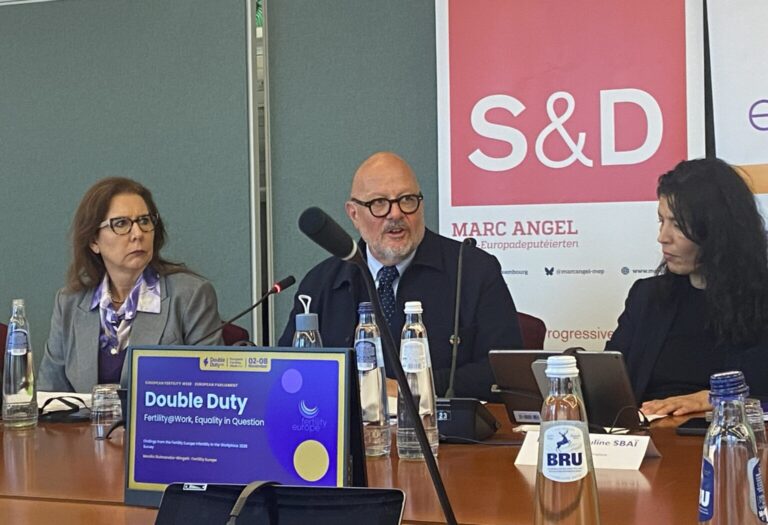
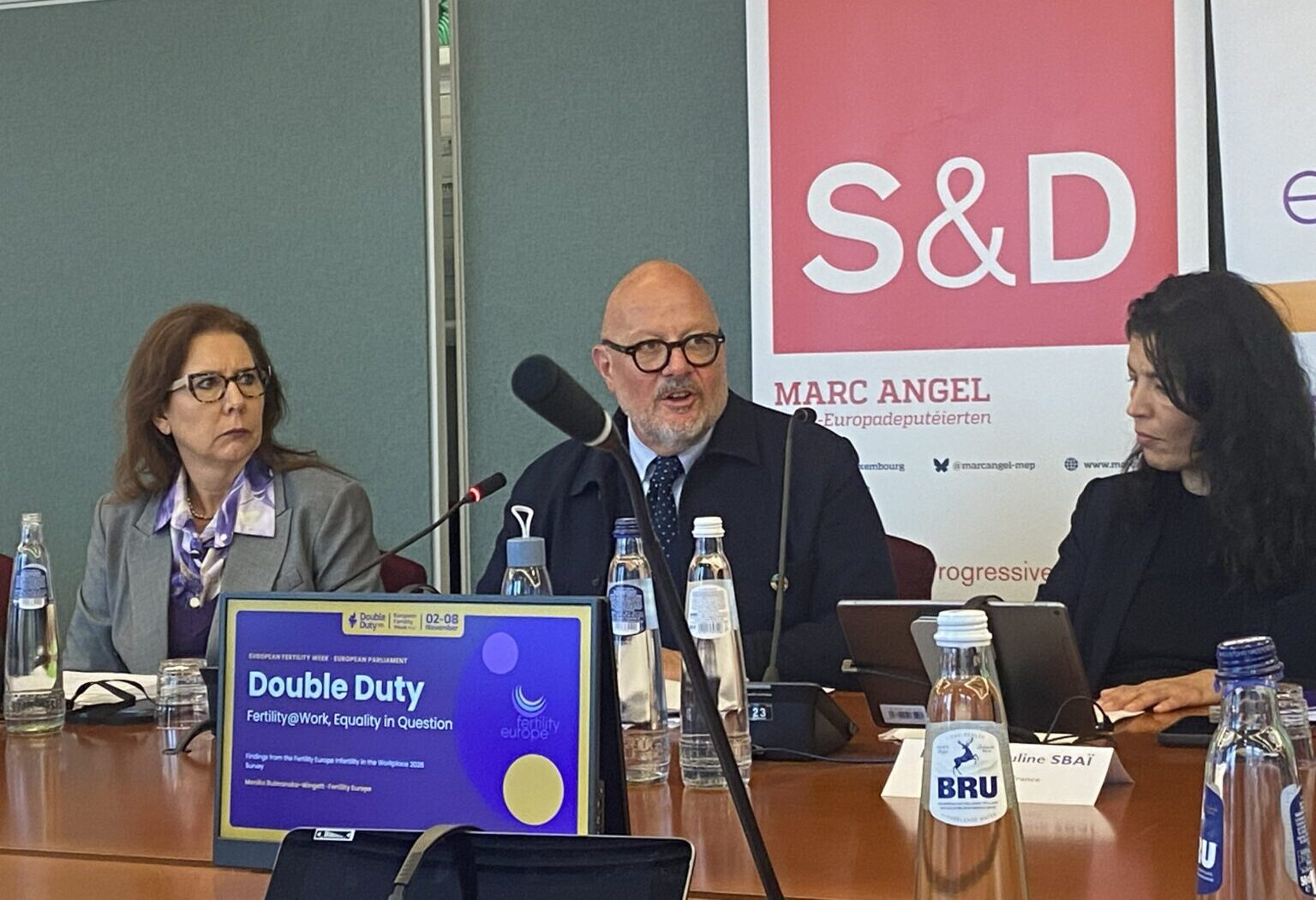
On 4 November 2026, during European Fertility Week, the Coalition for Fertility together with Fertility Europe launched the Double Duty report at the European Parliament. The evidence is clear: people in fertility treatment are carrying a second, invisible job, and the policy frameworks around them do nothing to help.
The event, Double Duty: Fertility@Work, Equality in Question, was hosted by Quaestor Marc Angel (S&D, Luxembourg) and co-hosted by MEP Majdouline Sbaï (Greens/EFA, France). Policymakers, trade unions, health experts, UNFPA and people with lived experience took part.
The evidence
The report draws on Fertility Europe’s Infertility in the Workplace survey: 2,717 respondents in 33 countries and territories.
- 90% experienced stress or anxiety balancing treatment with work
- 70.7% said infertility shaped their long-term career planning
- 61.7% feared negative consequences at work
- 84.3% said their employer had no fertility policy or support
- 96.3% of those who needed time off had to piece it together from sick, annual or unpaid leave
98.2% of respondents were women. Fertility treatment remains absent from EU equality and employment policy, and the burden falls on the women who are expected to manage it alone. They pay for treatment twice: once in clinic fees, and again in lost income, lost leave and lost career prospects.

Not a private matter
Mie Marie Brøggler from Denmark was dismissed weeks after telling her manager she would start fertility treatment. Almost five years later, the Danish Supreme Court found grounds to presume sex discrimination. Its ruling confirms that protection can apply before treatment has even begun. As she put it: “If a woman is afraid to tell her employer that she needs fertility treatment… can we really say that we have achieved equality?”
Quaestor Angel called infertility “a workplace issue, an equality issue and an issue of economic security.”
The keynote on equality came from Eva Schultz, Member of the Cabinet of Executive Vice-President Roxana Mînzatu, whose portfolio covers social rights, skills and quality jobs. She firmly connected Fertility at Work as a gender equality issue. She referred to Work-Life Balance Directive, Quality Jobs Act, Gender Equality Strategy, Union of Skills declared the Commission openness to dialogue with the Coalition.
What policymakers heard
- MEP Sbaï called for:
- the right to receive treatment without losing one’s job
- confidentiality
- protection from discrimination
- EU-level data collection on infertility
- protection for workers exposed to substances toxic for reproduction
- ETUC (Aline Brüser) set out fertility as a trade union issue. Workplace provisions must be open to everyone who needs them.
- Fertility Europe (Bojana Santic) said that goodwill from individual managers is not policy. She urged the Coalition to use the upcoming reporting on the Work-Life Balance Directive to push for change.
- European Institute for Women’s Health (Flavia Chiavelli) criticised the silos separating reproductive health, employment and gender equality policy. She called for a rights-based response to falling birth rates instead of pressure on individuals.
- ESHRE (Mariana Moura Ramos) made the case for psychologically informed workplace support.
- UNFPA (Birgit van Hout) said the real fertility crisis is one of choice and autonomy, not numbers.
What the Coalition is calling for
- The EU institutions: recognise fertility treatment explicitly in equality and employment policy, including the Work-Life Balance Directive review and the quality jobs agenda.
- Governments: create policies that guarantee time off for fertility treatment that does not rely on sick, annual or unpaid leave, with protection from dismissal across the whole treatment pathway.
- Employers: adopt clear, confidential fertility policies, developed with employees.
- Social partners: include fertility-related leave and flexibility in collective agreements.
Where someone lives or works should not decide whether they can combine fertility care with their job with dignity and security.